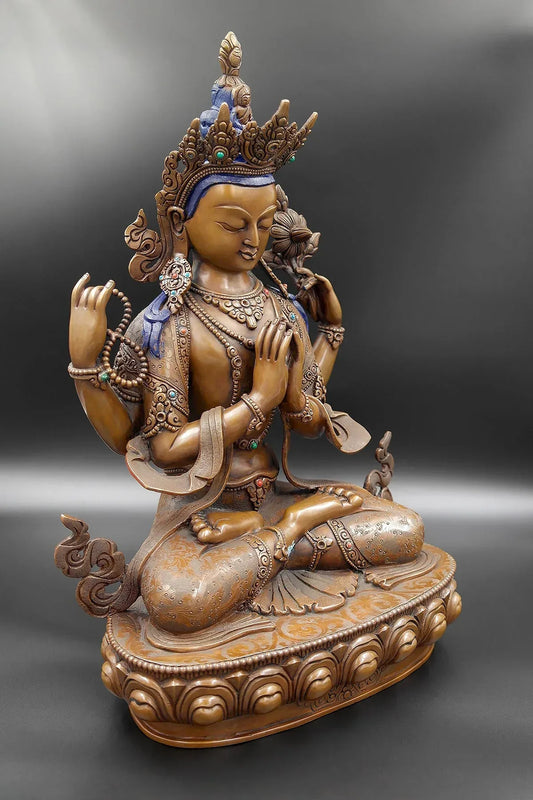
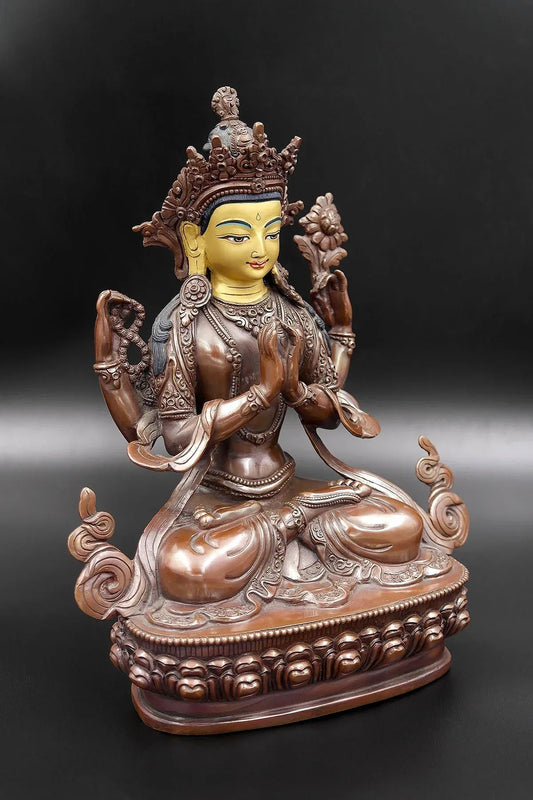
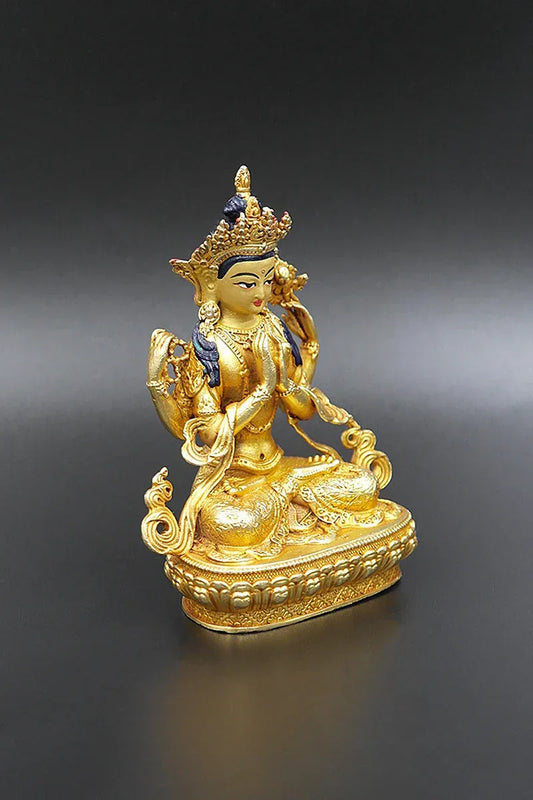
In Himalayan Buddhist culture, Chenrezig, or Avalokiteshvara, symbolizes compassion in its act of embodiment. His appearance is not about formalistic ritual participation but about being in the world in a sensitive, thoughtful, and aware fashion. It is because of this that there is a place in Himalayan culture, in family settings, monasteries, or private spaces, that is occupied by a Chenrezig statue.
Chenrezig is usually shown with a serenity that comes from an internally peaceful state. In most representations, his multiple arms represent the ability to respond to the suffering of many beings simultaneously; each hand is doing something different to help others. The prayer beads, the lotus, or any other ordinary thing that Chenrezig might hold in his hands signifies the importance of practicing wisely and having the right intentions. Nothing is meant to be loud but rather evokes the sense of compassionate actions such as listening, serving, and being there.
In terms of practical everyday life, the statue of Chenrezig also functions as a meditation point or a prayer point. Ideally, this is done in the morning or in the evenings. Here, one sits in front of the statue of Chenrezig as a way of focusing one's mind by relating to kindness, especially during tough moments. With time, the statue transitions from being a physical object to a presence.
The tradition of the Chenrezig statue has its roots in Himalayan Buddhist culture, specifically from the Nepali and Tibetan traditions. Skilled craftsmen require the expertise of metal-casting techniques, as well as the painstaking hand-carving process, all within specific guidelines of representation that have been handed down from generation to generation. Such pieces require the concentration of the craftsmen, whereby form, proportion, and expression are the focus and not speed, resulting in the piece being warmer than the usual factory-made product.
In Himalayan culture, these statues are not considered to be merely embellishments in a setting. In a culture, these are treated with reverence. These minute differences in expressions or textures are a reflection of the humanity involved in their creation, signifying that compassion is a practiced act. It is not a straightforward act; it is a very human act.
It could become an everyday reminder, in an intimate setting, to reflect prior to acting, to approach others with patience, or simply to tend with care to one’s own inner condition. The statue, in this way, becomes not an object to be displayed, an artifact, an ornament, or simply an ornament, but rather a constant companion.