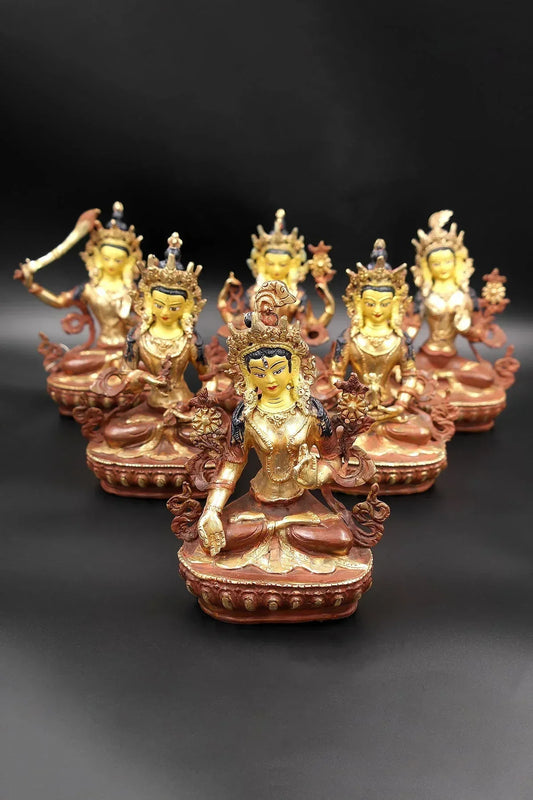
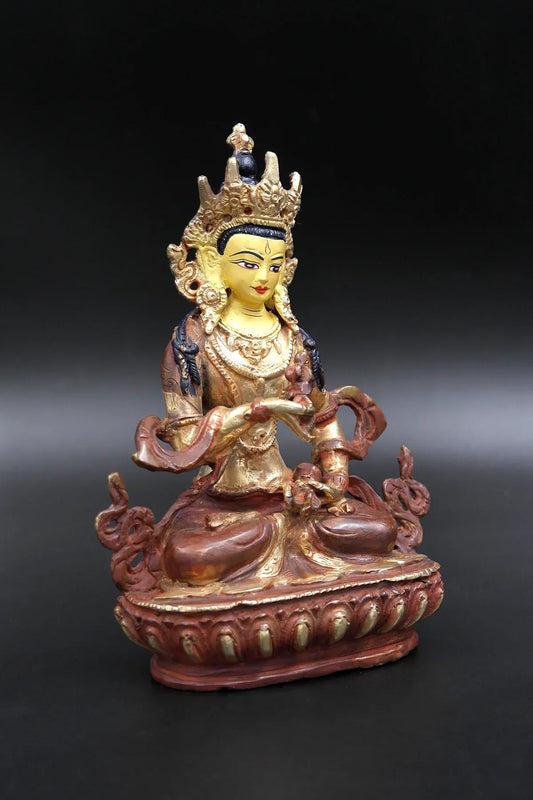
It is Vajrasattva who speaks in quiet words about this desire to return to enlightenment, Buddha of the Himalayas. "A figure of purification" is how he is sometimes known, in a meaning that is neither dramatic nor mystical, but to acknowledge that one is reminded that awareness, in its own way, has the power to mold thought. An icon of Vajrasattva is something more like a companion in this process than a figure who represents any kind of triumphant devotion founded upon either hope or fear.
Vajrasattva is white-complexioned, not because white is a mark of perfection, but more so because of his openness and honesty. In his hands, he holds a Vajra and a bell: the Vajra symbolizes clear awareness and unshakeable mindfulness, while the bell is a representation of wisdom and understanding of emptiness. In his overall pose, he is seated in a calm position, balanced, and centered. His face is mild, almost in a listening attitude, to remind one to wait before judging oneself or others.
In current usage, a Vajrasattva image may be found in meditation rooms or quiet areas in homes. Its purpose is for persons to sit in front of it when performing Vajrasattva meditation or reciting the Vajrasattva mantra as a focus for meditation on virtuous living and cleanliness. Such an image does not have transformative powers but is merely a symbol that marks the intention to observe, acknowledge, and release.
These statues hail from a very long tradition in the Himalayan region and specifically from Nepal, where Buddhist art has developed under the influence of ritual and life itself. The craft of these statues relies upon metalworking skills or very detailed carving, proportioned so as to reflect a long tradition of their making. They all possess minute variations of line and texture that derive from the rhythm of human fingers rather than machine-made accuracy. That’s where handmade Vajrasattva statues tread a slightly different path from mass-produced religious objects. They exude a sense of lived-through patience.
In Nepalese Buddhist art, Vajrasattva plays a crucial role in internal accountability. His appearance in art does not symbolize eliminating faults, but rather accepting them without failure or avoidance. A Tibetan statue of Vajrasattva would embody this concept in an image that balances meaning with suppressed duality.
Having a statue of Vajrasattva nearby can become a gentle nudge when one chooses to remember its presence. It simply exists; its gaze is fixed on clarity, accountability, and transformation. In its silence, one finds a place to pause and locate Himalayan Buddhism through a sense of mindfulness that celebrates awareness over purity.

 Sold out