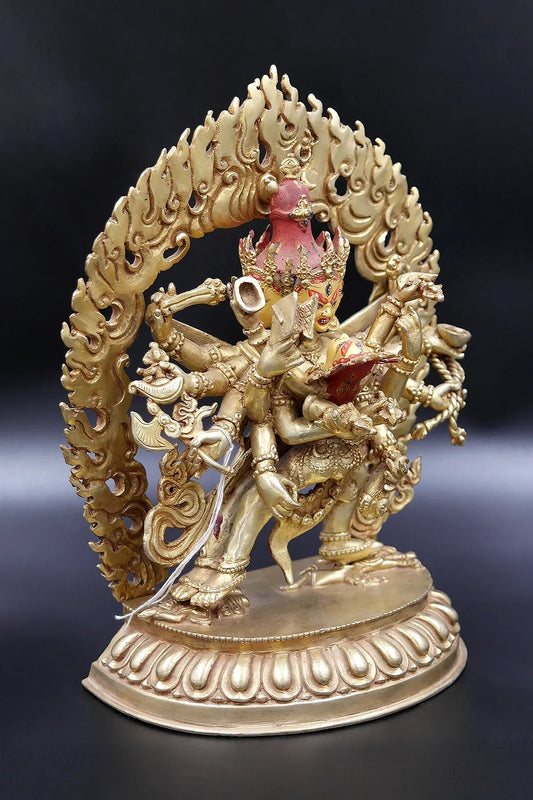
Chakrasamvara, better known as Heruka, in the Vajrayana Buddhist tradition, embodies a deeply thoughtful ideal of change within one’s own heart. Chakrasamvara stands not so much as a remote or frightening presence but as a meaningful representation of the ideal of the interdependent motion of knowledge and compassion. A Chakrasamvara statue may seem complex when one looks at it, but its underlying theme is a profoundly reflective one.
The representation of Chakrasamvara with multiple arms and an active position, embracing his consort, is not to be interpreted literally or ritualistically. They represent the combination of awareness and compassionate action, activity and passivity, and form and awareness. The multiple arms represent the ability to act properly in varying situations, and the energetic position indicates transformative action rather than aggression or combat. The representation in Vajrayana Buddhist art is intended to convey the necessity for the practitioner to look deeper than the surface phenomena and contemplate inside.
In traditional contexts, a Chakrasamvara statue is treated with reverence and consideration, particularly in advanced meditative environments. As a visual aid for reflection rather than guidance for practice, it is a statue that becomes increasingly less about symbols and more about being a presence to help remind one of clarity in times of confusion.
The tradition of carving Chakrasamvara statues also has a long history in the Himalayan region, especially in Nepal, where it is continued by skilful artisans. These artworks have subtle variations with their expressions and shape, which is due to the human hand involved in making the artwork, as opposed to the religious items made by machine production.
Coming back to the significance of the Himalayan art of the Buddhist era, the statue of Chakrasamvara has a certain relevance in the sense that it symbolises the first stage of the process of change, which is awareness. The very essence of the material and the technique with which it has been made point towards the same.
Having a Chakrasamvara statue around may be very helpful to reflect on transformation on the personal level or on taking responsibility in a meditative way. This reminds us in a subtle way of how wisdom and compassion must be balanced.